
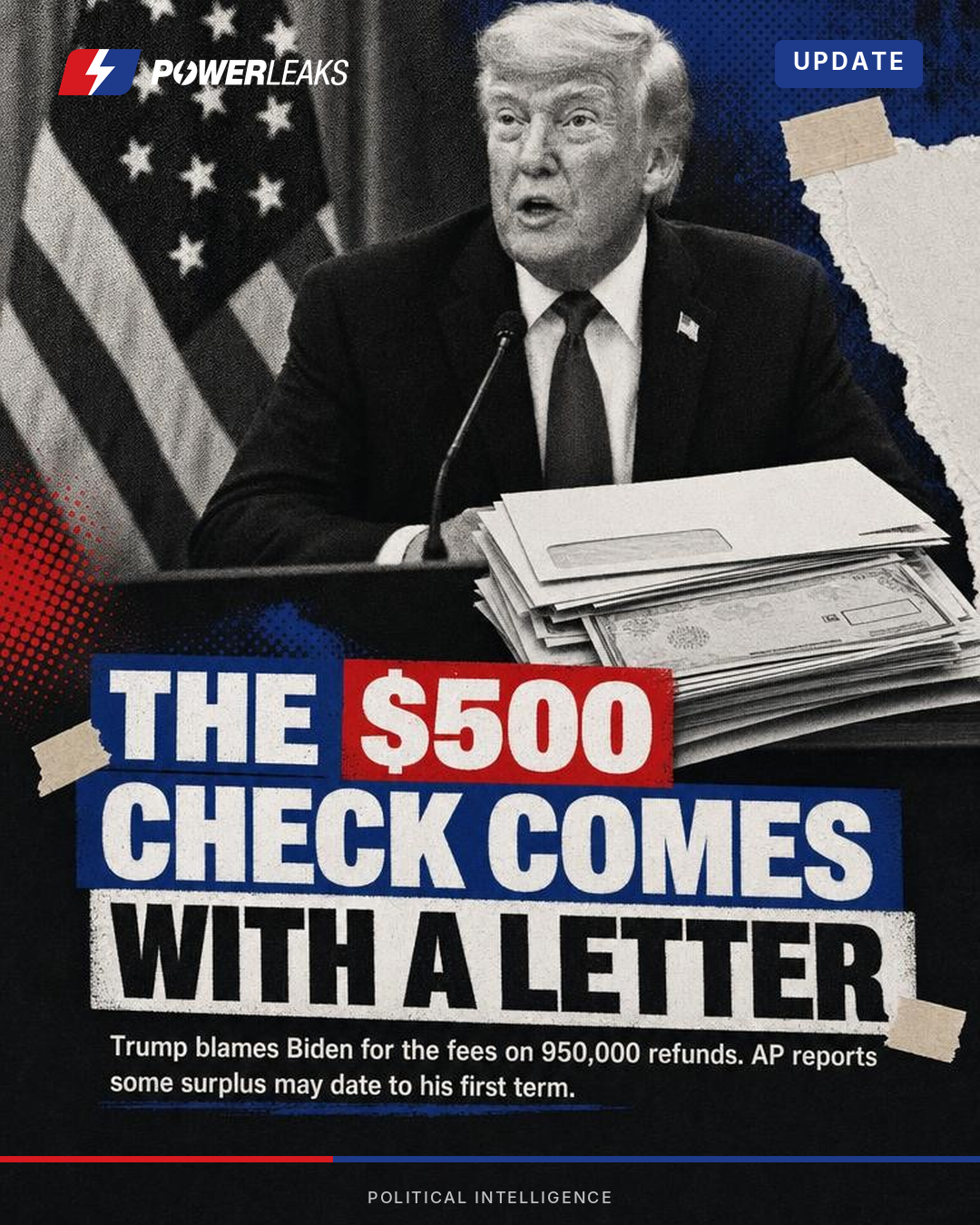
The Trump administration began sending $500 Obamacare refund checks on Wednesday (Sept. 30) to more than 950,000 Americans, and each one comes with a letter from the president blaming his predecessor.
The White House announced the program on Sept. 10. It says it is returning roughly $500 million in excess Affordable Care Act exchange user fees. The Treasury Department is distributing the money by check or direct deposit, according to administration officials cited by CNBC and CBS News. Households with more than one eligible person could get more than one $500 payment.
The letter is the story. "For years, the Biden Administration overcharged you to fund the operation of HealthCare.gov," Trump wrote, according to a copy obtained by CNBC. He added: "That money belongs to hard-working Americans, not the Government, and now I am returning it to you!" (That's per conservative outlet Newsmax's account of the CNBC copy. USA Today quotes the letter with slightly different wording.)
The White House says insurers paid the fees, that the costs showed up in premiums, and that they ran above what it takes to operate HealthCare.gov. In a post on X, the White House called it "more money back in YOUR wallet."
Developing, disputed: The "Biden overcharge" claim is the White House's. The Associated Press reported earlier this month that some of the surplus could have been collected during Trump's first term. KFF's Cynthia Cox said it was possible that at least some of the funds came from fees collected before Biden took office. The White House maintains that the Biden administration's management of the exchange produced the surplus.
Who gets a check, and who doesn't
The refunds mainly go to people with incomes above 400% of the federal poverty level, according to administration officials. In 2026 that is roughly $64,000 for an individual and $132,000 for a family of four. These people paid full price because they don't qualify for premium tax credits. Officials said some unsubsidized people between 100% and 400% of the poverty level could also qualify.
The program covers 30 states that use HealthCare.gov, per the administration. People in the other 20 states generally get nothing, because those states run their own exchanges. USA Today, citing the White House, says the federal government did not collect these user fees from enrollees there.
By the White House's numbers, as reported by USA Today, Texas leads with about 139,000 recipients. Florida has 127,900, Ohio 65,700, North Carolina 58,200, Wisconsin 56,200 and Michigan 55,100. USA Today notes that several of those states host closely contested Senate and House races.
The checks go out five weeks before the midterms, after the enhanced subsidies expired.
That timing is not subtle. USA Today reports that affordability is a political liability for Trump and Republicans heading into the November elections. The refunds also follow the end of the enhanced premium tax credits at the close of 2025, which Trump and congressional Republicans declined to extend, per USA Today.
Here is the plain part. Millions of people lost help paying for coverage this year, and the money coming back is a fraction of that. KFF reported that marketplace enrollment fell in 2026 for the first time in seven years. Reuters reported last week that roughly 3 million people left marketplace plans after the subsidies expired. Nearly 19.2 million were enrolled earlier this year, per government data cited by Reuters.
The $500 checks are separate from Trump's proposed $5,000 payment tied to Republicans keeping Congress, which would need congressional action. Per USA Today, Democrats have called that proposal a "bribe."
If you're in one of the 30 states, check your mailbox and your bank account. Either way, the next date to know is Nov. 1, when 2027 open enrollment begins. KFF estimates insurers are seeking a median 15% premium increase for next year, which is a lot more than $500 for anyone paying full price.