
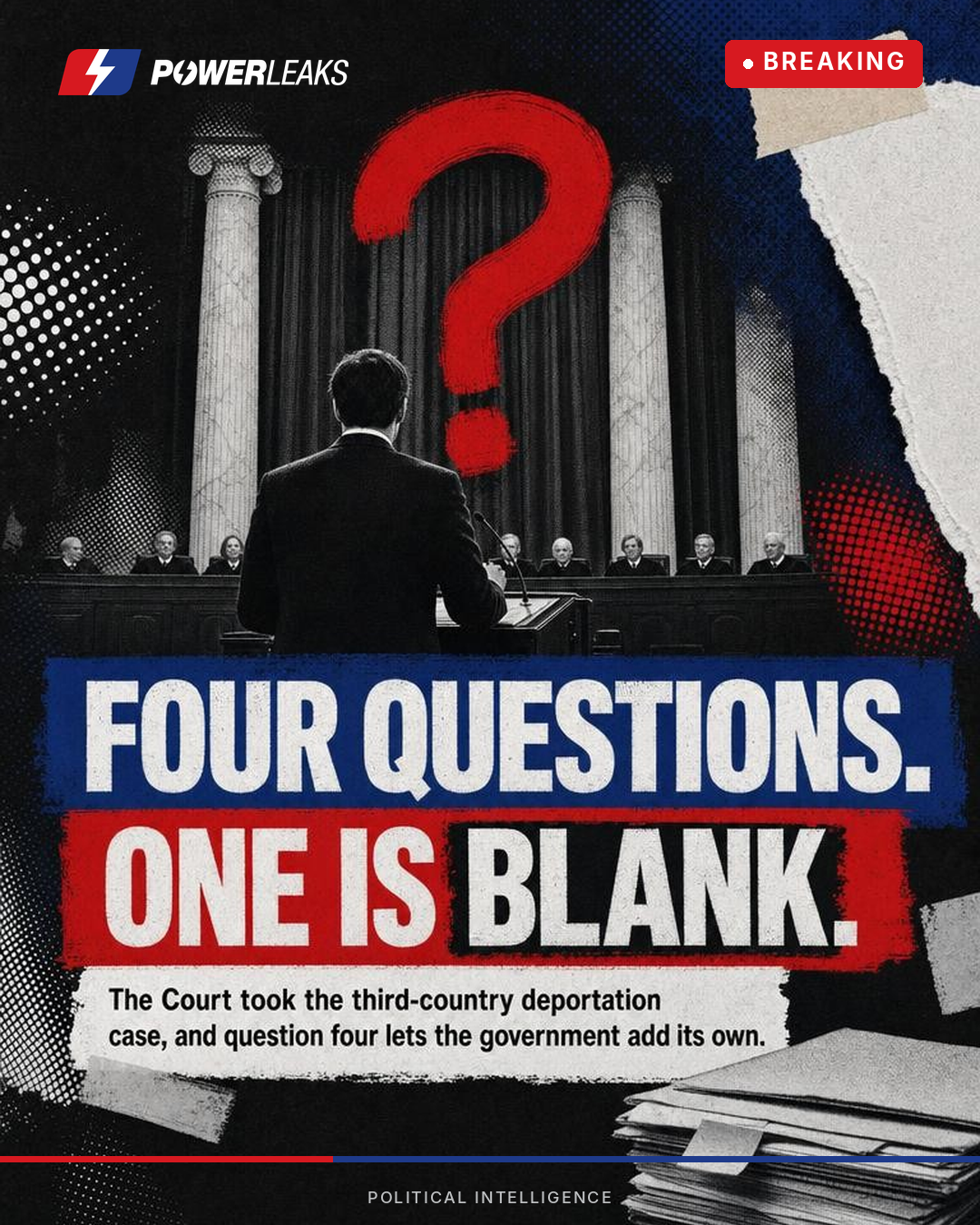
The Supreme Court has agreed to hear the Trump administration's third-country deportation case, and one of its four questions lets the government write its own.
The case is DHS v. DVD. It challenges the policy of deporting migrants to countries where they have no ties. The Court put it on its merits docket with oral arguments set for December, The Hill's Zach Schonfeld and Sophie Brams said on the outlet's video show The Gavel. The justices also issued an emergency ruling with the announcement, so the deportations continue while the case plays out.
The administration says the program focuses on serious criminals. Lower-court judges ruled it doesn't give migrants enough opportunity to raise claims that they would face torture in those countries. That is the core dispute.
The Court will take up three questions you'd expect. Does it have jurisdiction? Was the lower courts' remedy too broad? Is the policy unlawful?
Then comes the fourth. Schonfeld read it out on the show:
Such other questions that the government determines are appropriate for the proper disposition of the case.
Schonfeld described it as an invitation to Solicitor General John Sauer: anything else you want us to know, feel free to raise. He said he can't remember another case with a question like it. Brams said she has never seen one in her time covering the courts.
So what is the Court doing? The two say court watchers they spoke to wonder whether the justices want to be finished with the issue, and want everything on the table so they can decide it at once. They also note that cases like this often get tangled in procedural snafus the hosts call vehicle problems. Both are speculation. The Court has not explained the question.
Here is the plain part. Judges found that people sent to third countries may not get a real chance to say they could be tortured there. Those removals keep going while the justices think about it.
Schonfeld and Brams call it one of the first cases to squarely test a core Trump administration policy. The administration has had a mixed record at the Court. It already has the emergency ruling it wanted, and now it waits for the final sign-off after December's arguments.