
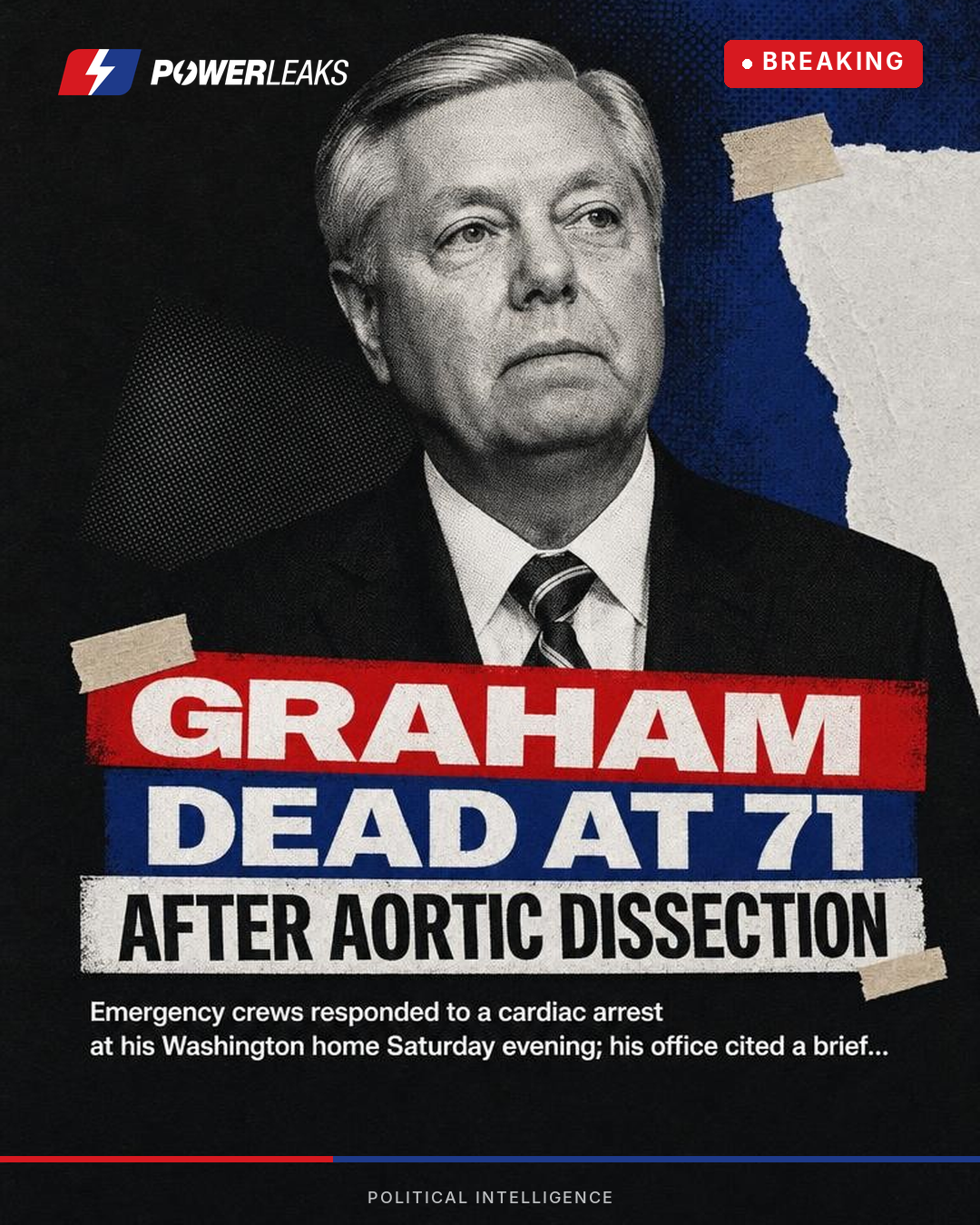
U.S. Senator Lindsey Graham (R-SC) died Saturday evening (July 11) at 71 after emergency personnel responded to his Washington home on a reported cardiac arrest, according to NBC News.
The DC Medical Examiner's preliminary findings cite an aortic dissection — a tearing of the aortic wall — caused by Arteriosclerotic Cardiovascular Disease. Graham's office announced the death on X, describing a "brief and sudden illness."
Graham had served in the Senate since 2003 and was seeking a fifth term. He had just returned from Kyiv, where on Friday (July 10) he toured a classified Ukrainian drone facility known as "Skyfall," viewing the country's "Baba Yaga" Vampire bomber drones, Shrike FPVs, and P1-SUN Shahed interceptors, along with new technology not yet on the battlefield.
In Kyiv, Graham announced an upcoming Russian sanctions package, declaring: "I believe that it would be a huge mistake for America not to cooperate with Ukraine in the field of drones."
President Trump said Graham called him around 6:30 p.m. Saturday (July 11), shortly before his death.
He was full of vim and vigor. He was tired. He said "I'm tired" because it's a long trip. But, other than that, he was fine.
Trump told CNN's Jake Tapper on Sunday (July 12): "He called me last night. He just got back from Ukraine. And he had a great trip. He was pushing very, very hard. You probably know he wanted to do the SAVE America Act."
Trump also appeared on NBC's Meet the Press, telling host Kristen Walker that Graham called to say, "We're all set for the Save America Act." Trump said he thought the two might meet on Sunday (July 12). "And then that was it."
According to Axios, Graham briefed Trump on Saturday (July 11) about his Ukraine visit and an ongoing congressional push to impose sanctions on Russia. Graham reportedly joked to an unnamed individual on Saturday: "I can't die now. I still need to do the Russia sanctions, get Iran sorted out, and do Israeli-Saudi normalization."
Trump learned of Graham's death around 2:00 a.m. Sunday (July 12). Medical personnel, Trump said, arrived shortly after Graham's call.
On State of the Union, Trump called Graham "a great politician," "a natural," and "a tough cookie." He acknowledged their friction during the 2016 campaign: "It was a nasty campaign. He was tough and nasty, but I was nasty too. And it worked out fine."
Tapper characterized Graham as a warmonger with "a strong belief in interventionism," and Trump agreed. Asked how much influence Graham had on his foreign policy, Trump said the two "disagreed a little bit," especially on Ukraine. "I wanted to see the war with Ukraine end very quickly. I think he was more into keeping it going, frankly. He was very, very militant having to do with that," Trump said. "From the standpoint of 25,000 people dying every month, I didn't like that."
On a replacement, Trump told Meet the Press: "I have somebody that I think would be great. But I don't want to say it now because, you know, it's too soon with Lindsey."
Earlier Sunday (July 12), Trump posted on Truth Social: "Senator Lindsey Graham, one of the greatest people and Senators I have ever known, is dead! He was always working, and was a true American Patriot. Lindsey will be greatly missed."
Graham had toured the Skyfall factory just days before his death and met with Ukrainian President Volodymyr Zelenskyy. Zelenskyy paid tribute, describing Graham as "a true defender of freedom and of the values that make our world safer," noting the senator had visited Ukraine ten times during the war.
Ukrainian Foreign Minister Andrii Sybiha called Graham a "true friend" and "one of the strongest voices" supporting Ukraine. NATO Secretary-General Mark Rutte described him as "a powerful advocate for America who believed strongly in the NATO Alliance."
Fox News host Sean Hannity called Graham "a dear friend and the hardest working man in the US Senate."
Graham was on an Iranian kill list. Days before his death, Trump had said that if he was assassinated, the U.S. should "bomb them at levels never seen before."
Graham was a once-fierce Trump critic who became one of his most loyal supporters, consistently backing a strong U.S. military posture overseas and a hard line against Iran.
Whether Graham's Iran posture and his presence on an Iranian kill list had any bearing on his death remains an open question — the medical examiner's preliminary findings point to natural causes.