
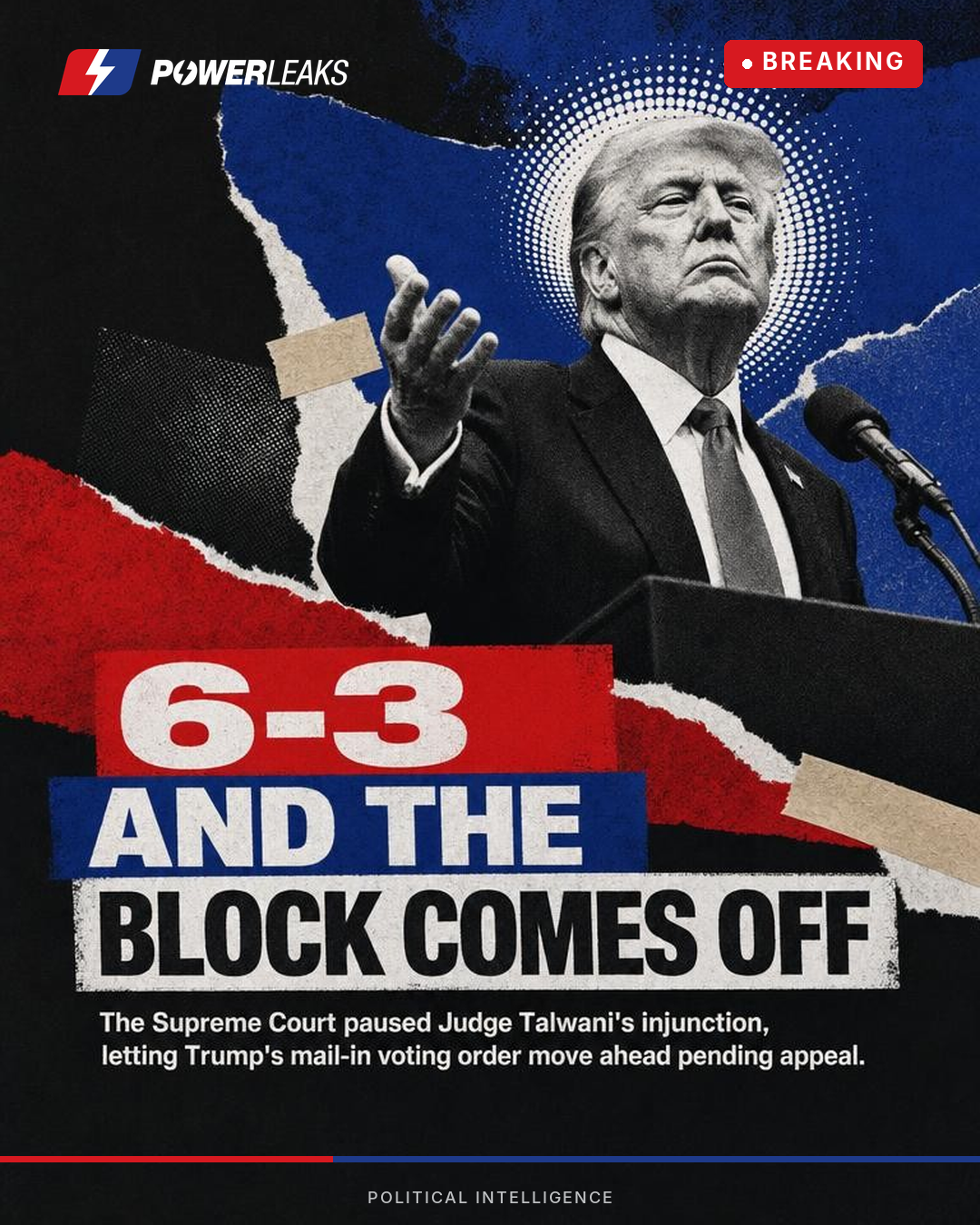
The Supreme Court voted 6-3 on Monday (August 24) to pause a lower court injunction blocking President Trump's mail-in voting executive order, granting the administration's emergency application to stay a June ruling by Massachusetts-based District Judge Indira Talwani.
The unsigned per curiam ruling clears the way for the administration to begin implementing the directive ahead of the 2026 midterms while the appellate process runs its course — and sets up a potential return to the high court for a ruling on the merits.
The Court found the administration is likely to succeed on its argument that Talwani lacked jurisdiction, and that her injunction "is causing it irreparable harm, and that the equities do not favor leaving the injunction in place while [its] appeal is pending." The majority wrote that "the Order itself does not harm the States, so the District Court lacked jurisdiction to bar the Government from trying to implement it."
As described by Fox News, the executive order "directs the Department of Homeland Security to compile a list of all adult U.S. citizens living in each state and would direct [the U.S. Postal Service] to deliver mail ballots only to individuals appearing on the lists." The Postal Service published a related rule on Friday mandating that states "provide lists of voters who received mail-in ballots," according to Fox.
Talwani, an Obama appointee whom The Federalist described as a past Democrat donor, issued her injunction barring the order from taking effect in the states that challenged it. The administration appealed to the First Circuit Court of Appeals but was rejected. The government did, however, score a separate win in a challenge before the D.C. Circuit Court of Appeals, which ruled late last month that the challengers' lawsuit was unreviewable because the named agencies hadn't yet implemented their official rules as required by the president's order.
The Supreme Court's majority cautioned that its ruling "does not mean that any measure taken by the Government to implement the Order will necessarily be lawful." While "time will tell" on that front, the justices concluded the injunction itself likely causes irreparable harm if left in place during the appellate process.
The stay is pending "the disposition of the appeal in the United States Court of Appeals for the First Circuit and disposition of a petition for a writ of certiorari in this Court, if such a writ is timely sought." The stay terminates if the Court denies a potential cert petition from the administration, or if the Court agrees to take up the case and rules on the merits.
Justice Sonia Sotomayor, writing for herself and Justice Elena Kagan, argued the states' challenges "are justiciable now" and that a "commonsense reading of the Executive Order, corroborated by the Government's own representations, makes clear that the respondent States face a sufficiently concrete and imminent injury to satisfy Article III."
Justice Ketanji Brown Jackson penned a solo dissent spanning 23 pages — longer than the per curiam opinion and Sotomayor's dissent combined. She contended the Court's granting of relief "violates well-established precedents concerning this Court's equitable discretion and needlessly injects chaos and uncertainty into the upcoming midterm elections."
States administering elections and the voting public that relies on them to do so deserve clarity, not caginess or confusion.
"The Court does a disservice to all concerned by distorting Article III standing and ripeness principles to issue a ruling that contributes to pre-election chaos instead of quashing it, and by using its equitable authority to facilitate a patently inequitable result," Jackson wrote.
The application was presented to Justice Jackson in No. 26A124 and referred by her to the full Court. With the stay in place, the First Circuit now weighs the appeal — and the justices may get another crack at the order itself before 2026.