
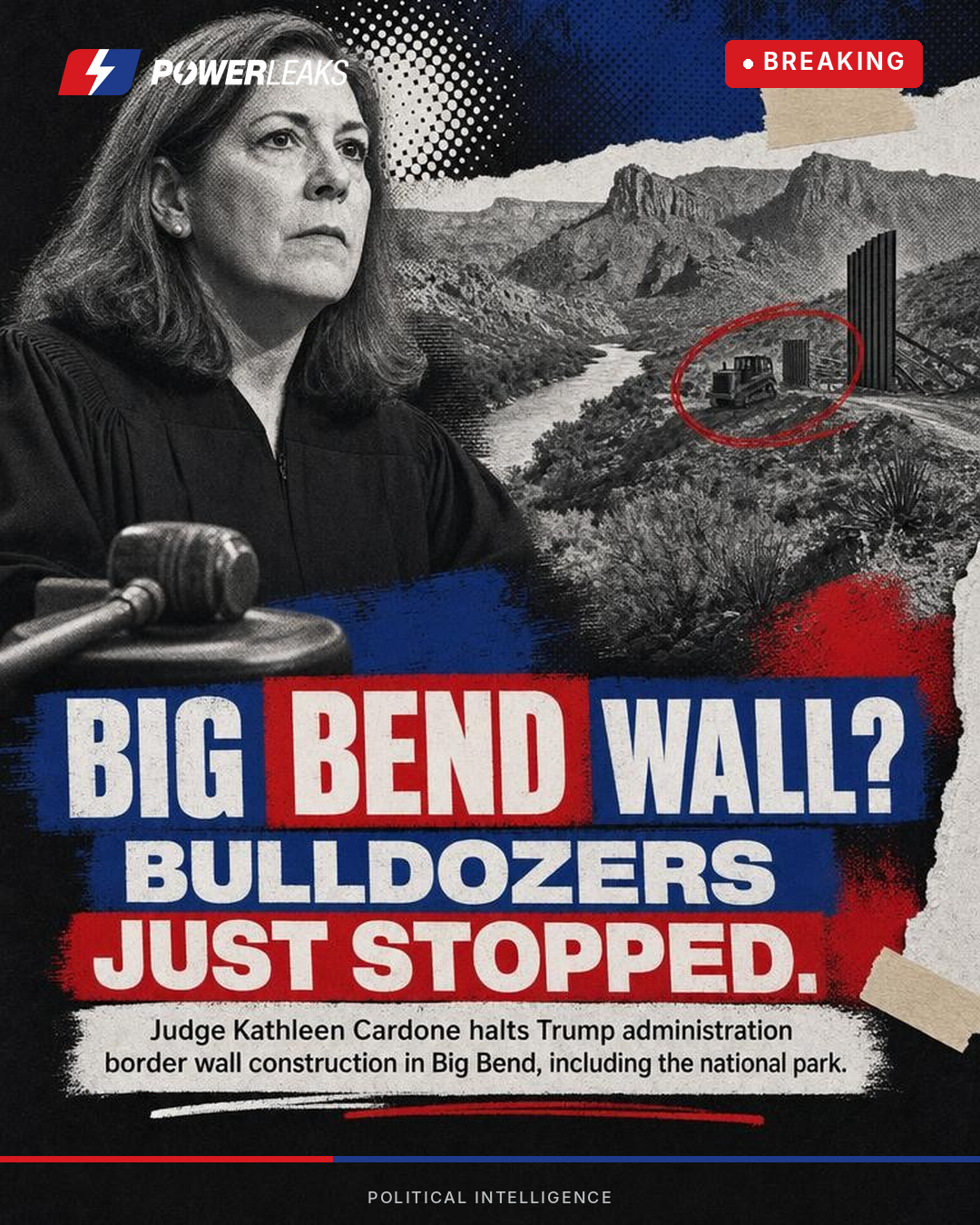
A federal judge on Friday ordered the Trump administration to stop building border wall in Big Bend, including inside Big Bend National Park.
U.S. District Judge Kathleen Cardone granted a preliminary injunction, Axios reports. The administration is barred, for now, from building border barrier or related infrastructure, or engaging in any "construction or ground disturbing activities" in the Big Bend sector. The Texas Tribune reports she read the order aloud from the bench at the end of Friday's hearing, after asking the courtroom to remain calm.
Cardone ruled that the plaintiffs' constitutional claims were likely to succeed, the Tribune reports. The injunction stays in effect while the suit plays out in court. Right-leaning outlet The Gateway Pundit, which flagged the ruling, says the order also covers patrol roads and describes Cardone as a George W. Bush appointee. It says contractors' bulldozing and road-clearing is now stopped.
Who sued, and why
The Center for Biological Diversity, an environmental advocacy group, filed the suit in April against the Department of Homeland Security and its secretary, per the Tribune. The plaintiffs are the Friends of the Ruidosa Church, a nonprofit preserving a historic church in Presidio County, and Danny William Miller. Miller is a Rio Grande river guide and landowner who stands to lose his property in Redford to the wall.
The suit targets five contracted border wall projects in the region. It argues they are unconstitutional for several reasons, including violating the separation of powers and depriving citizens of their land. The Gateway Pundit summarizes the argument as the construction lacking approval from Congress.
The courtroom testimony was blunt, according to the Tribune. Miller compared the government building a wall across his property and cutting off his river access to "a bullet to the head." He said his work would become "a tour of the military industrial complex, rather than a tour of the wilderness." Hudspeth County resident Bill Guerra-Addington testified that a barrier would be a death sentence for his ranch. "They're taking the river away from us, and it's devastating," he said.
Center for Biological Diversity lawyer Zeynep Graves said in closing arguments: "The harm reaches far beyond the landscape itself."
The government's case, and the numbers
The government says physical barriers are necessary even in remote, lightly trafficked areas like Big Bend. It says they are needed to achieve what it calls "operational control," defined as zero unauthorized crossings, the Tribune reports.
"Since the President took office, DHS has delivered the most secure border in history," former DHS Secretary Kristi Noem wrote in waivers that eased contracting laws across the southwest border. "More can be done, however."
Here is the part the waiver language skips. According to the Tribune:
The sector covers about a quarter of the border and sees between 1% and 3% of migrant apprehensions.
That figure covers apprehensions by U.S. Customs and Border Protection each year. The sector includes Big Bend National Park and Big Bend Ranch State Park.
NBC News correspondent Ryan Chandler, who says he has been to Big Bend three times this year, describes the opposition as bipartisan and organic. He says it spans Republican sheriffs and Democratic ranchers who argue the wall will not help them. He also describes the terrain as desert with mountain barriers. The Tribune says the backlash began after news of the plans broke in January 2026 and slowly pushed the government to adjust them.
Axios notes the administration had already paused construction in the park in August. CBP Commissioner Rodney Scott said then that he would visit and talk with local stakeholders. Axios calls Friday's decision a loss for the Department of Homeland Security in its push to rapidly expand the southwestern wall.
If you are keeping score at home: the government wanted zero crossings in a sector with a sliver of the apprehensions, and a judge has told it to put the bulldozers down. Cardone's injunction against ground disturbing activities stays in place while the lawsuit continues.